
Hezbollah’s Financing Ecosystem Crime Families as a Case Study The Tajideen Clan
This article is the third in a series of articles exploring the critical role of crime families within Hezbollah’s financial network.
Azani, E. & Atiyas-Lvovsky, L. (2026). Hezbollah’s Financing Ecosystem Crime Families as a Case Study The Tajideen Clan. CENTEF. https://centef.org/research-publication/hezbollahs-financing-ecosystem/
Abstract
The Tajideen family originally from Lebanon, moved temporarily to Africa during the 1950s.[2] Three brothers, Kassim Tajideen (designated by the U.S. Department of the Treasury in 2009), as well as Hussain and Ali Tajideen (designated in 2010), were sanctioned for providing financial support to Hezbollah.[3] In 2010, the US Department of the Treasury announced the involvement of the Tajideen brothers in financing Hezbollah and imposed sanctions on their economic activities. US authorities assessed that their business network in The Gambia, Sierra Leone, Angola, Lebanon, the British Virgin Islands, and the Congo generated millions of dollars for Hezbollah.[4] The family’s business portfolio spans food processing (poultry and rice markets), real estate, as well as construction and diamonds.[5]
Despite the sanctions, the family restructured their operations using shell companies and new business names to conduct international transactions in huge amounts of money. This continued financial activity drew increasing international law enforcement attention to the family’s operations and their alleged sanctions evasion mechanisms. Following a high-profile extradition from Morocco and a subsequent guilty plea for money laundering in U.S. federal court, Kassim Tajideen was sentenced to prison in 2019[6] but granted an early compassionate release in 2020 due to COVID-19 health risks.[7]
Although the prosecution of Kassim Tajideen was a major success for Project Cassandra, a multi-year investigation led by the Drug Enforcement Administration (DEA) targeting Hezbollah’s global logistics and financing arm, this case highlights the complexity of Hezbollah’s financing networks on the one hand, and on the other, the difficulty in dismantling the organization’s global logistics and financing arm.[8]
The Tajideen Family Network and Roles
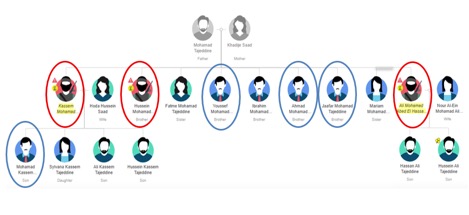
The Tajideen Clan[9] (Marked in red circle are siblings who have been designated by the US authorities. Marked in blue circle are family members involved in the economic network who have not been designated)
Kassim (Kassem) Tajideen: Was born in Sierra Leone in March 1955 before returning with his family to Lebanon. When he returned to Africa in the 1970s, he held citizenship from Sierra Leone, Lebanon, and Belgium.[10] Kassim built the family’s multibillion-dollar commodities empire across Africa, the Middle East, and Europe.[11] He was designated a Specially Designated Global Terrorist (SDGT) in 2009 for contributing tens of millions of dollars to Hizballah and was sentenced to five years in U.S. prison in 2019.[12]
Ali Tajideen: A former Hezbollah commander in Tyre, Lebanon. Described by the U.S. Treasury as a major player in “Jihad al-Binna,” a Hezbollah-linked construction company.[13] He was designated by the U.S. Treasury in 2010.[14]
Hussein (Husayn) Tajideen: Was born in Gambia and identified as a primary Hezbollah fundraiser and supporter.[15] He maintained close ties with high-level Gambian political figures, including former President Yahya Jammeh. Hussein was designated as an SDGT by the U.S. Treasury in 2010.[16]
Ahmad Tajideen: Primarily located in the Democratic Republic of Congo (DRC) and known for maintaining close relationships with the governments of former DRC leaders Mobutu Sese Seko and Joseph Kabila, which helped him secure business monopolies and lucrative contracts. Was never sanctioned by the US Department of Treasury, however, his company Congo Futur conglomerate, was sanctioned in 2010.[17]
Other family members have been linked to the network, including the late Hassan Tajideen, who was accused of supporting Hezbollah prior to his death in a 2010 plane crash. Senior Hezbollah officials attended his funeral, indicating the organization’s close ties to the organization.[18] During his life, he was a businessman who joined his brother Kassim in Sierra Leone in the late 1970s to expand their retail operations.[19]
In addition, Mohamed Tajideen, Kassim’s son, manages real estate holdings in Dubai Africa and Beirut, however, he is not accused of connections to Hezbollah.[20]
Core Business Network and Geographic Operations
The family’s activities are concentrated in several key countries, exploiting in some countries weak rule of law and local corruption.
Glory Group / Congo Futur
Glory Group emerged as a conglomerate incorporating companies that had previously been associated with Congo Futur’s business activities. When Congo Futur was sanctioned in 2010, some of its subsidiaries were transferred to Glory Group. These companies include Simmokin in the real estate sector, Société Congolaise de Construction Moderne (SCCM), the forestry company Cotrefor, and Union Invest.[21]
Historically, the group was led by Ahmad Tajideen and owned by his brother Kassim, but de facto managed by Youssef Sliman. Also involved are the wife of Ahmad Tajideen, as well as Abd Hassan Farhat, who hold shares in Congo Futur.[22]
Epsilon Trading FZE registered in the United Arab Emirates served to move funds within the network. Between 2013 and 2017, companies affiliated with the Glory Group transferred over $88 million to this entity for the purported purchase of various goods, such as food products and diesel engines. In addition, Kassim Tajideen admitted in 2018 the use of Epsilon Trading FZE to launder money and circumvent U.S. sanctions.[23]
Cotrefor (Compagnie de Transport et d’Exploitation Forestière) is a major forestry and logging company based in the Democratic Republic of the Congo (DRC). It is widely recognized as a successor of the company Trans-M (Trans-M S.P.R.L.), a subsidiary of the sanctioned Congo Futur conglomerate. It was found that certain forestry concessions previously associated with Cotrefor were transferred to a new entity, Industrie Forestière du Congo (IFCO).[24] The company has been described as the single largest exporter of Congolese timber to international markets, including customers in the U.S. and Europe.[25] The company gained significant political clout through its links to former DRC President Joseph Kabila and his brother.[26] It has been reported that Trans-M/Cotrefor received favorable treatment in the DRC, including tax exemptions and financial advantages.[27]
The ties to the Congolese government continue, as the Société Congolaise de Construction Moderne (SCCM), received $12.9 million over the years from the Ministry of Finance to build buildings in Kinshasa.[28]
Another company related to the Tajeddine network is Crown Mining, established in the DRC in 2012, holding an exploration permit for gold, copper, cobalt, and diamonds and tin. Ahmad Tajeddine apparently left Crown Mining in 2017.[29]
It should be noted that many of Congo Futur’s subsidiaries have never been sanctioned.
Tajco
Ali, Hussein, and Kassim Tajideen led Tajco, a multinational company dealing in real estate and international trade.[30] According to reports, in the early-mid 1990’s, bribes payments of millions of dollars were transferred from Tajco accounts to politicians, including the then President of Gambia, Yahya Jammeh, who described the Lebanese diaspora (including the Tajideen family) as the “backbone” of the state.[31]
Through Tajco Ltd (Gambia), Tajco imports various food and agricultural products as well as household items from Lebanon to a warehouse in Kairaba, which are then sold by Kairaba Supermarket, a subsidiary of Tajco Ltd. For both companies, Hussein Tajideen was reported as the point of contact.[32] Kairaba Supermarket (Kairaba Shopping Centre) is one of West Africa’s largest agricultural and food importers.[33] It has reportedly been used to enable international trade and conceal the illicit movement of funds and goods.[34] Kairaba Supermarket was designated in 2010.[35]
It was reported that the ownership of Kairaba Shopping Centre Co. Ltd Banjul is split among three primary shareholders, including: Tajco which is owned by the Tajideen family,[36] Hicham Nmer Khanafer as well as Mohamed Bazzi, both Hezbollah fundraisers designated in 2013 and 2018, respectively.[37]
Youssef Muhammad Tajideen, brother of the designated Tajideen brothers, is listed to be involved in many Tajideen holdings linked to Hezbollah, such as: Tajco Company SAE, Afrimex (Offshore) SAL, Hyram Maritime SAL, Al-Massar Real Estate SAL, Al-Dalhamiya Country Club Company, Union Real Estate Development Company SAL, Lebanese Real Estate Development & Investment Company SAL and others. Specifically, Afrimex (Offshore) SAL is also linked to the designated Ayman Joumaa’s network, involved in drug trafficking and money laundering.[38]
An investigation into the Tajideen family’s real estate investments in the suburbs of Beirut, carried out through Tajco and other entities controlled by the family and figures associated with Congo Futur, exposed a particularly prominent project known as Garden City. This was a mixed-use residential and commercial development in the Bir Hassan neighborhood of Beirut. According to researcher Yasmin Hassan Farhat, who studied land acquisitions in Bir Hassan on the basis of sectarian affiliation, the project was part of a strategy of territorial takeover implemented by various Shiite developers affiliated with Hezbollah and the Amal Movement. This strategy included transferring development rights to “approved developers,” a well-connected Shiite elite linked to centers of power, such as the Tajideen family. According to Farhat, the Garden City company acquired the land on which the project was built in 2007, and in 2010 Tajco, one of the main developers, was tasked with implementing the residential project.[39]
In this regard, it should be noted that the leader of the Progressive Socialist Party, Walid Jumblatt, accused the Tajideen family of purchasing land between southern Lebanon and Mount Lebanon for the purpose of facilitating Hezbollah’s military expansion in several Lebanese villages.[40] This claim is supported by the testimony of Nicholas Blanford, a researcher at the Atlantic Council based in Beirut. According to Blanford, following the 2006 Second Lebanon War, Hezbollah moved northward toward the Litani River, into the hills adjacent to the small Christian village of al-Qatraneh and the Druze village of al-Sriri. During this period, Christian and Druze residents reported extensive real estate investments in their areas by Ali Tajideen, who paid cash to local residents in order to acquire their land. This activity was intended to create a Shiite corridor between Nabatieh and southwestern al-Biqaʿ, thereby providing Hezbollah with territorial continuity. In this case, according to the U.S. Treasury, Ali Tajeddine used Tajco SARL (operating as Tajco Company LLC) as the main entity to obtaining and developing these properties, on behalf of Hezbollah.[41]
According to reports from 2020-2021, Ali Tajideen’s son, Hassan Ali Tajideen, has taken over Tajco as CEO and director. He was reported to also be the chairman, majority shareholder (50%), and authorized signatory of the Lebanese importing company of ready-made houses and construction material – Société Orientale Libanaise d’Investissement et Développement SAL (SOLID). The reports claim that his mother, Nur al-Ain Muhammad Ali Atwi, also served on the board of this company. In addition, Hassan Ali Tajideen was reported to be involved in the company Atlas Holding, a designated Lebanon-based company linked to the Martyrs Foundation which is part of Hizballah’s network. The auditor in both companies was reported to be the designated global terrorist Jihad Muhammad Qansu.[42]
Soafrimex
In 1989, Kassim Tajideen established a business headquarters in Antwerp, Belgium. His company, Soafrimex, became a major exporter of food commodities to Africa. Kassim’s wife, Huda Saad, as well as his brothers Ahmed and Jaafar Tajeddine were also involved in the company.[43] Soafrimex allegedly operated as an importer and exporter of food commodities such as rice and flour to Sierra Leone, Angola, Mozambique, Ghana, and Gambia, but presumably served as a cover for smuggling doubtful origin diamonds (“blood diamonds”) into Europe. The diamond transfers were carried out together with the food shipments. In addition, the company was accused of major tax fraud and money laundering.[44]
In May 2003, Belgian Judicial Police raided Soafrimex’s offices, arrested Kassim Tajideen and his wife, and froze the company’s bank accounts. Although terror-financing charges were eventually dropped in a Belgian court in 2009, the family was fined for financial irregularities.[45] After the legal troubles in Belgium, Kassim Tajideen and his wife subsequently fled to Beirut while on bail, where they restructured and folded Soafrimex into Ovlas Trading SA.[46]
Ovlas Trading SA
Ovlas Trading S.A. is a central corporate vehicle within the Tajideen network, designated as a Specially Designated Global Terrorist (SDGT) entity by the U.S. Treasury in December 2010. The company was a parent company for an extensive network of subsidiaries across Africa, the Middle East, and Europe, primarily operating in food manufacturing, general trading, and construction industries. As mentioned above, Soafrimex was the predecessor entity whose business functions and network were transitioned into the Ovlas umbrella.[47]
Ovlas operates through two primary registered hubs: one in the British Virgin Islands and another in Beirut, Lebanon. The following subsidiaries mainly operate in Angola and were sanctioned in 2010 alongside their parent company, Ovlas Trading, although continue to operate in US dollars also after the designation:[48]
- Golfrate Holdings mainly operated in Angola and is a wholly owned subsidiary of Ovlas Trading.
- Grupo Arosfran was established in 1991 by Kassim Tajideen in Luanda, Angola. The company is registered by the Treasury Department as a branch or subsidiary of Ovlas Trading across multiple international business hubs.
- Afri Belg Commercio e Industria Lda, a subsidiary of Ovlas Trading, deals with import of food and household items.
According to reports, although the Tajideen family claims Kassim’s non-involvement in Congo Futur, transactions between Ovlas Trading subsidiaries and Congo Futur subsidiaries indicate otherwise. In 2013, despite sanctions, it was revealed that three companies belonging to the Ovlas group – Leaders of Supply and Products (Offshore) SAL, Global and Infinite Traders, and Galaxy Flame Trading, supplied 85% of the needs of Atlantic Trade Company (ATCOM), a subsidiary of Congo Futur.[49] Despite these connections, none of these companies have been sanctioned.
Key people in the Tajideen network
Amer Afif Abu Khalil
Amer Afif Abu Khalil is an attorney based in Tyre who is closely associated with the Tajideen network.[50] He serves as a lawyer and manager to more than 40 Lebanese-registered companies, of which many belong to the Tajideen family or are directly connected to it, according to the Second Amended Complaint in Bartlett v. Societe Generale de Banque au Liban, SAL. Many of these companies are linked by common ownership and familial relationships, and several are described as having links to Hezbollah-related networks.[51]
A number of these companies have been named in the U.S. Office of Foreign Assets Control (OFAC) for their terrorism-related activities. Other companies are not themselves designated, but were established or controlled by persons who are designated by OFAC and have documented ties to Hezbollah. In addition, Abu Khalil offers direct legal representation to some OFAC-designated companies. He also has a brother, Maher Afif Abu Khalil, who is connected with Hezbollah and has an account at Al-Qard al-Hasan.[52]
Using 240 Analytics, several Lebanese-registered companies owned by Tajideen family members for which Amer Afif Abu Khalil acts as attorney were identified:[53]
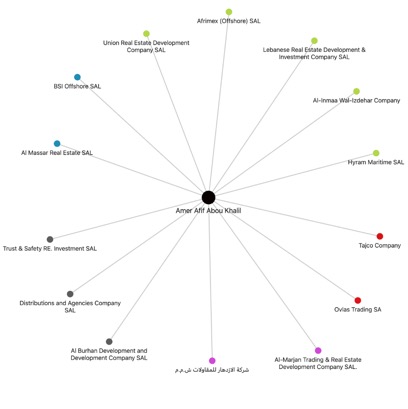
- Companies related to Kassem Mohamad Tajideen (designated)
- Companies related to Youssef Mohamad Tajideen
- Companies related to Ahmad Mohamad Tajideen
- Companies related to Ali Mohamad Abed El Hassan Tajideen (designated)
- Companies related to other Tajideen family members
Out of these companies two were officially designated by the US OFAC: Tajco Company and Ovlas Trading SA.[54]
In another context, it should be noted that official records from the Lebanese Ministry of Interior and Municipalities, show that Amer Afif Abu Khalil was a founding member of the Educational and Guidance Charitable Association, established in Tyre in April 2009, whose headquarters are on Property No. 988 / Section 122 in Tyre, owned by Youssef Muhammad Tajideen.[55]
Chawki Raef Abou Khalil
Through his auditor position, Chawki Raef Abou Khalil, has important links to the Tajideen network by being the Auditor of multiple Lebanese registered Tajideen companies such as the designated Ovlas Trading SA. There is also an overlap in the network between Chawki and the lawyer Amer Afif Abu Khalil. The pattern in most of the cases shows that in the companies where auditor is Chawki Raef Abou Khalil, Amer Afif Abu Khalil is the legal counsel. This repeated instance of auditor-lawyer relationship may imply an operationally tight bridge between Chawki Raef Abou Khalil and Amer Afif Abu Khalil.
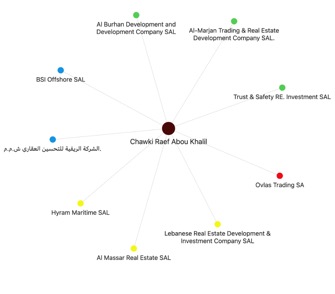
Network diagram of companies audited by Chawki Raef Abou Khalil
In addition, it seems that the Lebanese registered company named الشركة الريفية للتحسين العقاري ش.م.م. (Rural Real Estate Improvement Company LLC) appears to provide a corporate link between the Tajideen and the Nazem Ahmad network. Chawki Raef Abu Khalil servers as an auditor in the company while among its partners is Ibrahim Mohamad Tajideen, (one of the founders of Tajco Company and sibling to Hussein and Kassem Tajideen) as well as Nazem Ahmad.[56]
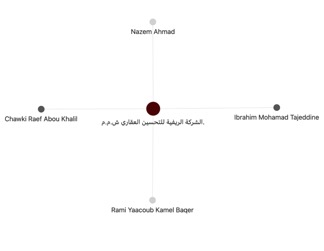
Network diagram of the Rural Real Estate Improvement Company LLC linking Nazem Ahmad, Chawki Raef Abou Khalil, Ibrahim Mohamad Tajeddine and Rami Yaacoub Kamel Baqer
Summary and insights
The Tajideen clan has demonstrated a complex and highly sophisticated network of business operations and financial activities that ultimately contributed to Hezbollah’s financing. Through a range of legitimate businesses, as well as front and shell companies across various industries in Africa and Europe.[57]
The scale of this deception was revealed by the U.S. Drug Enforcement Administration’s (DEA) “Project Cassandra,” a multi-year investigation into Hezbollah’s global logistics arm. This led to an 11-count indictment against Kassim Tajideen for conspiracy, fraud and money laundering, though he pleaded not guilty to all charges. U.S. authorities alleged that following his May 2009 terrorist designation, Tajideen secretly restructured his business and, alongside conspirators, used new business names and misrepresented ownership to complete at least 47 wire transfers totaling more than $27 million to unwitting U.S. vendors. Additionally, the U.S. Justice Department was reportedly investigating whether sales of wheat flour from the Kansas-based food-processing giant Seaboard Corp. were masked to firms linked to Tajideen. In his defense, Tajideen denied supporting Hezbollah, claiming his actions were conflated with those of his brother and that he had been actively working with U.S. authorities for several years to be removed from the blacklist.[58]
Despite sanctions, key members of the clan continue to operate through complex financial transactions, illustrating their adaptability in evading financial controls. They achieve this by passing the main companies onto other family members who have not been sanctioned, thereby avoiding regulatory oversight. Therefore, investigations into these people and other smaller clan businesses are necessary.
Moreover, the links between Tajideen enterprises and other Hezbollah-affiliated individuals and governments highlight a broad and well-coordinated effort to sustain Hezbollah’s activities, creating a resilient network despite sanctions. In this regard, attention should be paid to the connections between different networks associated with Hezbollah. For example, connections between the Tajideen network and Khanafer, Bazzi, Joumaa, Qansu, Nazem and others.
Another important aspect that warrants attention is the role of key individuals within companies, such as lawyers and auditors. The data indicates that there are cases in which these professionals are associated with multiple companies, some of which have been designated.
Finally, the ongoing operations of various Tajideen entities, even after legal actions and sanctions, suggest that current sanctions are insufficient in disrupting these financial flows.
Appendix
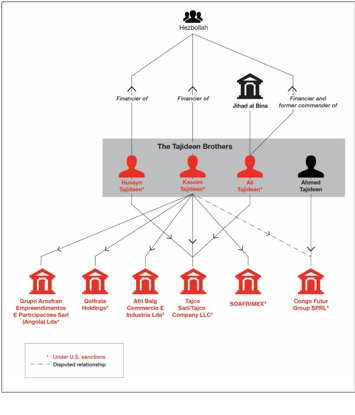
Diagram of the Tajideen brothers, Hezbollah, and companies under U.S. sanctions
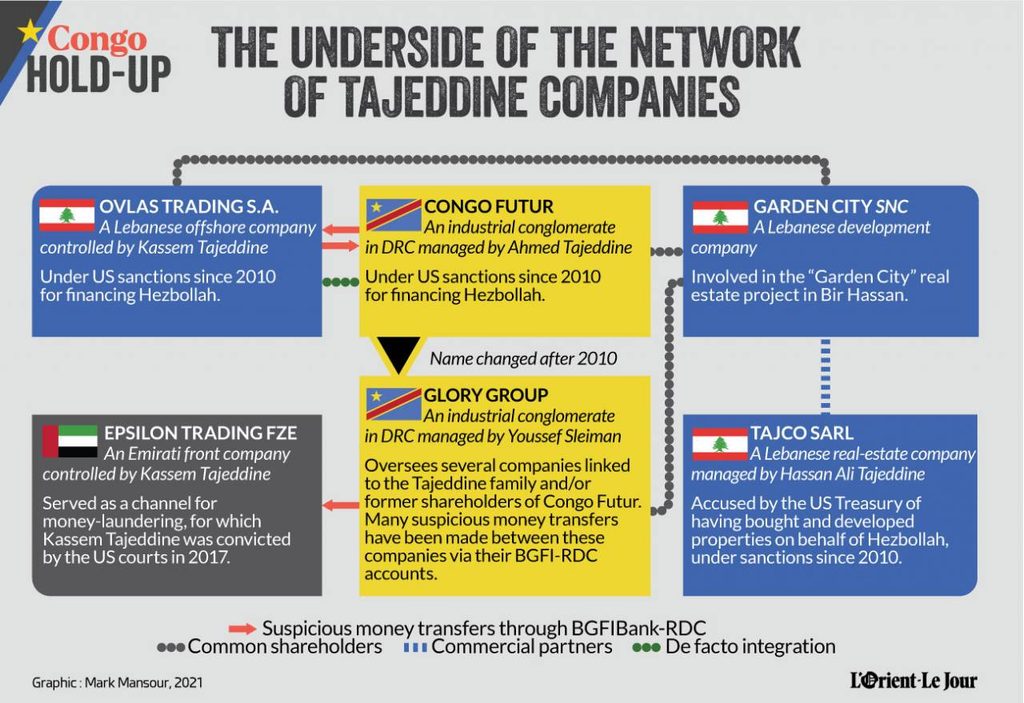
Diagram relating to companies owned by the Tajideen family[59]
About the ICT
The International Institute for Counter-Terrorism (ICT) is one of the leading academic institutes for counter-terrorism in the world. Using a multidisciplinary approach, the ICT work to facilitate international cooperation in the global struggle against terrorism.
As an independent think-do-tank, the ICT focuses on themes related to terrorism, counterterrorism, homeland security, threat vulnerability, risk assessment, intelligence analysis, national security, and defense policy.
Serving as a joint forum for international policymakers and scholars, the ICT draws upon the experiences of a comprehensive and international network of individuals and organizations with unique expertise on terrorism and counter-terrorism research, public policy analysis and education.
In addition to publishing research papers, situation reports and academic publications for worldwide distribution, the ICT hosts a number of international seminars, workshops and conferences to discuss and educate followers on global and regional issues of security, defense, and public policy in order to better facilitate the exchange of perspectives, information and proposals for policy action.
Licensing and Distribution
ICT publications are published in an open-access format and are distributed under the terms of the Creative Commons Attribution-NonCommercial-NoDerivatives 4.0 International Public License, which permits the non-commercial re-use, distribution, and reproduction in any medium, provided the original work is properly cited, and is not altered, transformed, or built upon in any way.
Footnotes
[1] The authors wish to thank Dr. Michael Barak, Senior Researcher and Team Leader of the Global Jihad & Jihadi Websites Monitoring Group at the International Institute for Counter-Terrorism (ICT), for his assistance and insightful analysis during this project.
The authors would like to express their sincere gratitude to Mr. János Bogányi, Former Intern and the ICT, for valuable research assistance, particularly in information collection and data analysis.
The authors would also like to thank Mr. Avishai Sober, Former Intern at the ICT, for valuable research assistance during the initial stages of the project, including support with research coordination and project development.
This research was conducted with the generous backing, expertise, and funding of CENTEF, Center for Research of Terror Financing (www.centef.org). We extend our sincere gratitude for their comprehensive support of this project.
This research was made possible through the support of 240 Analytics (https://240analytics.com) and the use of its advanced research platform. The platform facilitated the identification of concealed networks of personal and commercial relationships in the context of terror financing and terror.
[2] https://www.acams.org/en/opinion/lessons-learned-from-kassim-tajideen-case; https://www.washingtonpost.com/local/public-safety/lebanese-businessman-hezbollah-supporter-charged-with-evading-us-terror-sanctions/2017/03/24/979dbbd2-10b6-11e7-ab07-07d9f521f6b5_story.html?utm_term=.200856779db3
[3] https://home.treasury.gov/news/press-releases/tg997
[4] https://www.washingtonpost.com/local/public-safety/lebanese-businessman-hezbollah-supporter-charged-with-evading-us-terror-sanctions/2017/03/24/979dbbd2-10b6-11e7-ab07-07d9f521f6b5_story.html?utm_term=.200856779db3
[5] https://www.washingtonpost.com/local/public-safety/lebanese-businessman-hezbollah-supporter-charged-with-evading-us-terror-sanctions/2017/03/24/979dbbd2-10b6-11e7-ab07-07d9f521f6b5_story.html?utm_term=.200856779db3; https://www.counterextremism.com/extremists/kassim-tajideen
[6] https://www.acams.org/en/opinion/lessons-learned-from-kassim-tajideen-case
[7] https://www.jpost.com/international/jailed-hezbollah-financier-granted-early-release-returned-to-lebanon-632201
[8] https://www.washingtonpost.com/local/public-safety/lebanese-businessman-hezbollah-supporter-charged-with-evading-us-terror-sanctions/2017/03/24/979dbbd2-10b6-11e7-ab07-07d9f521f6b5_story.html?utm_term=.200856779db3
[9] Source: 240 Analytics.
[10] https://www.acamstoday.org/lessons-learned-from-kassim-tajideen-case/; https://www.washingtonpost.com/local/public-safety/lebanese-businessman-hezbollah-supporter-charged-with-evading-us-terror-sanctions/2017/03/24/979dbbd2-10b6-11e7-ab07-07d9f521f6b5_story.html?utm_term=.200856779db3; https://www.ict.org.il/UserFiles/ICTWPS%20-%20Dan%20Levy%20-%2012.pdf; https://www.theguardian.com/world/iran-blog/2016/may/25/kassim-tajideen-us-treasury-hezbollah-tehranbureau
[11] https://www.washingtonpost.com/local/public-safety/lebanese-businessman-hezbollah-supporter-charged-with-evading-us-terror-sanctions/2017/03/24/979dbbd2-10b6-11e7-ab07-07d9f521f6b5_story.html?utm_term=.200856779db3
[12] https://www.acams.org/en/opinion/lessons-learned-from-kassim-tajideen-case; https://www.washingtonpost.com/local/public-safety/lebanese-businessman-hezbollah-supporter-charged-with-evading-us-terror-sanctions/2017/03/24/979dbbd2-10b6-11e7-ab07-07d9f521f6b5_story.html?utm_term=.200856779db3; https://sanctionssearch.ofac.treas.gov/Details.aspx?id=11494; https://www.theguardian.com/world/iran-blog/2016/may/25/kassim-tajideen-us-treasury-hezbollah-tehranbureau
[13] https://home.treasury.gov/news/press-releases/tg997; https://www.fdd.org/analysis/2021/05/11/hezbollahs-al-qard-al-hasan-and-lebanons-banking-sector/; https://deirezzor24.net/en/the-iranian-backed-jihad-al-bina-organization-resumes-its-activities-in-al-bukamal/
[14] https://home.treasury.gov/news/press-releases/tg997; https://www.osenlaw.com/sites/default/files/2021-12-31BARTLETT%202d%20Amended%20Complaint%20-Redacted.pdf; https://www.acams.org/en/opinion/lessons-learned-from-kassim-tajideen-case; https://www.counterextremism.com/extremists/ali-tajideen
[15] https://home.treasury.gov/news/press-releases/tg997
[16] https://www.ict.org.il/UserFiles/ICTWPS%20-%20Dan%20Levy%20-%2012.pdf; https://ofac.treasury.gov/recent-actions/20180517; https://home.treasury.gov/news/press-releases/tg997; https://www.counterextremism.com/extremists/hussain-tajideen
[17] https://www.ict.org.il/UserFiles/ICTWPS%20-%20Dan%20Levy%20-%2012.pdf; https://sanctionssearch.ofac.treas.gov/Details.aspx?id=12454
[18] https://www.theguardian.com/world/iran-blog/2016/may/25/kassim-tajideen-us-treasury-hezbollah-tehranbureau; https://www.ict.org.il/UserFiles/ICTWPS%20-%20Dan%20Levy%20-%2012.pdf; https://ofac.treasury.gov/recent-actions/20180517; https://www.washingtonpost.com/local/public-safety/lebanese-businessman-hezbollah-supporter-charged-with-evading-us-terror-sanctions/2017/03/24/979dbbd2-10b6-11e7-ab07-07d9f521f6b5_story.html?utm_term=.200856779db3
[19] https://www.theguardian.com/world/iran-blog/2016/may/25/kassim-tajideen-us-treasury-hezbollah-tehranbureau
[20] https://www.occrp.org/en/project/dubais-golden-sands/mohamed-tajideen
[21] https://www.publiceye.ch/fr/coin-medias/communiques-de-presse/detail/congo-hold-up-un-reseau-libanais-sous-sanctions-touchait-a-geneve-les-millions-dun-douteux-commerce-de-viande; https://today.lorientlejour.com/article/1282561/how-did-the-network-of-tajeddine-companies-circumvent-us-sanctions-against-hezbollah.html; https://thesentry.org/wp-content/uploads/2016/09/TerroristsTreasury_TheSentry_October2017_final.pdf; https://home.treasury.gov/news/press-releases/tg997
[22] https://www.publiceye.ch/fr/coin-medias/communiques-de-presse/detail/congo-hold-up-un-reseau-libanais-sous-sanctions-touchait-a-geneve-les-millions-dun-douteux-commerce-de-viande; https://today.lorientlejour.com/article/1282561/how-did-the-network-of-tajeddine-companies-circumvent-us-sanctions-against-hezbollah.html; https://home.treasury.gov/news/press-releases/tg997; https://thesentry.org/wp-content/uploads/2016/09/TerroristsTreasury_TheSentry_October2017_final.pdf
[23] https://today.lorientlejour.com/article/1282561/how-did-the-network-of-tajeddine-companies-circumvent-us-sanctions-against-hezbollah.html
[24] https://thesentry.org/wp-content/uploads/2016/09/TerroristsTreasury_TheSentry_October2017_final.pdf; https://today.lorientlejour.com/article/1282561/how-did-the-network-of-tajeddine-companies-circumvent-us-sanctions-against-hezbollah.html; https://medd.gouv.cd/wp-content/uploads/2021/07/PA_1811Alibuku_2ndDepot.pdf; https://www.ict.org.il/UserFiles/ICTWPS%20-%20Dan%20Levy%20-%2012.pdf; https://congovirtuel.com/information/les-barons-de-la-foret-congolaise-une-concession-de-plus-de-275-000-ha-dans-la-province-de-la-tshuapa-appartenant-au-libanais-ahmed-tajeddine-ex-patron-de-congo-futur/
[25] https://thesentry.org/wp-content/uploads/2016/09/TerroristsTreasury_TheSentry_October2017_final.pdf
[26] https://today.lorientlejour.com/article/1282561/how-did-the-network-of-tajeddine-companies-circumvent-us-sanctions-against-hezbollah.html; https://www.acams.org/en/opinion/lessons-learned-from-kassim-tajideen-case
[27] https://congovirtuel.com/information/les-barons-de-la-foret-congolaise-une-concession-de-plus-de-275-000-ha-dans-la-province-de-la-tshuapa-appartenant-au-libanais-ahmed-tajeddine-ex-patron-de-congo-futur/; https://thesentry.org/wp-content/uploads/2016/09/TerroristsTreasury_TheSentry_October2017_final.pdf
[28] https://thesentry.org/wp-content/uploads/2016/09/TerroristsTreasury_TheSentry_October2017_final.pdf; https://today.lorientlejour.com/article/1282561/how-did-the-network-of-tajeddine-companies-circumvent-us-sanctions-against-hezbollah.html
[29] https://gw.hacdn.io/media/documents/Renewable_energy_at_what_cost_EN_Janaury_2022.pdf
[30] https://www.accessgambia.com/information/tajco.html; https://home.treasury.gov/news/press-releases/tg997
[31] https://www.ict.org.il/UserFiles/ICTWPS%20-%20Dan%20Levy%20-%2012.pdf
[32] https://dctransparency.com/hezbollahs-not-so-secret-millionaire-business-with-gambia/; https://www.counterextremism.com/extremists/hussain-tajideen; https://www.reuters.com/article/world/an-african-supermarket-with-a-sinister-side-idUSBRE86C19I/
[33] https://www.osenlaw.com/sites/default/files/2021-12-31BARTLETT%202d%20Amended%20Complaint%20-Redacted.pdf; https://dctransparency.com/hezbollahs-not-so-secret-millionaire-business-with-gambia/; https://home.treasury.gov/news/press-releases/tg997; https://www.ict.org.il/UserFiles/ICTWPS%20-%20Dan%20Levy%20-%2012.pdf
[34] https://www.acamstoday.org/lessons-learned-from-kassim-tajideen-case/
[35] https://home.treasury.gov/news/press-releases/tg997
[36] https://dctransparency.com/hezbollahs-not-so-secret-millionaire-business-with-gambia/
[37] https://ofac.treasury.gov/recent-actions/20180517; https://sanctionssearch.ofac.treas.gov/Details.aspx?id=13396
[38] https://www.osenlaw.com/sites/default/files/2021-12-31BARTLETT%202d%20Amended%20Complaint%20-Redacted.pdf; https://home.treasury.gov/news/press-releases/tg1624
[39] https://today.lorientlejour.com/article/1282561/how-did-the-network-of-tajeddine-companies-circumvent-us-sanctions-against-hezbollah.html
[40] https://janoubia.com/2020/07/23/the-tajideen-brothers-from-the-mountains-of-south-lebanon-to-tajco-and-its-many-branches/
[41] https://today.lorientlejour.com/article/1282561/how-did-the-network-of-tajeddine-companies-circumvent-us-sanctions-against-hezbollah.html
[42] https://today.lorientlejour.com/article/1282561/how-did-the-network-of-tajeddine-companies-circumvent-us-sanctions-against-hezbollah.html; https://www.osenlaw.com/sites/default/files/2021-12-31BARTLETT%202d%20Amended%20Complaint%20-Redacted.pdf; https://home.treasury.gov/news/press-releases/sm917
[43] https://www.ajc.org/news/hezbollahs-international-presence-and-operations; https://today.lorientlejour.com/article/1282561/how-did-the-network-of-tajeddine-companies-circumvent-us-sanctions-against-hezbollah.html; https://www.osenlaw.com/sites/default/files/2021-12-31BARTLETT%202d%20Amended%20Complaint%20-Redacted.pdf; https://www.acamstoday.org/lessons-learned-from-kassim-tajideen-case/
[44] https://www.acamstoday.org/lessons-learned-from-kassim-tajideen-case/; https://www.ajc.org/news/hezbollahs-international-presence-and-operations
[45] https://www.ajc.org/news/hezbollahs-international-presence-and-operations; https://thesentry.org/wp-content/uploads/2016/09/TerroristsTreasury_TheSentry_October2017_final.pdf; https://www.counterextremism.com/extremists/kassim-tajideen; https://www.theguardian.com/world/iran-blog/2016/may/25/kassim-tajideen-us-treasury-hezbollah-tehranbureau; http://idexonline.com/FullArticle?id=32413; https://www.acams.org/en/opinion/lessons-learned-from-kassim-tajideen-case; Matthew Levitt, Hezbollah: The Global Footprint of Lebanon’s Party of God (Georgetown University Press: Washington D.C.), September 2013, p. 258.
[46] https://www.osenlaw.com/sites/default/files/2021-12-31BARTLETT%202d%20Amended%20Complaint%20-Redacted.pdf; https://dctransparency.com/hezbollahs-not-so-secret-millionaire-business-with-gambia/
[47] https://www.osenlaw.com/sites/default/files/2021-12-31BARTLETT%202d%20Amended%20Complaint%20-Redacted.pdf; https://home.treasury.gov/news/press-releases/tg997; https://dctransparency.com/hezbollahs-not-so-secret-millionaire-business-with-gambia/
[48] https://www.acamstoday.org/lessons-learned-from-kassim-tajideen-case/; https://home.treasury.gov/news/press-releases/tg997; https://thesentry.org/wp-content/uploads/2016/09/TerroristsTreasury_TheSentry_October2017_final.pdf; https://www.opensanctions.org/entities/NK-CRomcGPfi9bB3BEqTibfqZ/
[49] https://thesentry.org/wp-content/uploads/2016/09/TerroristsTreasury_TheSentry_October2017_final.pdf; https://www.osenlaw.com/sites/default/files/2021-12-31BARTLETT%202d%20Amended%20Complaint%20-Redacted.pdf
[50] https://home.treasury.gov/news/press-releases/tg997
[51] https://www.osenlaw.com/sites/default/files/12-31-20_BARTLETT_2d_Amended_Complaint_FINAL_(ECF).pdf
[52] 240 Analytics.
[53] Some of the companies had limited or incomplete information.
[54] https://home.treasury.gov/news/press-releases/tg997
[55] http://77.42.251.205/LawArticles.aspx?LawArticleID=897106&LawId=223065
[56] https://240kg.com/company/lbn/247479?entity_type=person&context_id=6ece649d-120c-4aef-947c-ab659b974433&name=Ibrahim+Mohamad+Tajeddine
[57] https://www.acamstoday.org/lessons-learned-from-kassim-tajideen-case/
[58] https://www.washingtonpost.com/local/public-safety/lebanese-businessman-hezbollah-supporter-charged-with-evading-us-terror-sanctions/2017/03/24/979dbbd2-10b6-11e7-ab07-07d9f521f6b5_story.html?utm_term=.200856779db3
[59] “The Terrorists’ Treasury”, The Sentry, October 2017.
[60] https://today.lorientlejour.com/article/1282561/how-did-the-network-of-tajeddine-companies-circumvent-us-sanctions-against-hezbollah.html
