
CENTEF Hosts Virtual Round Table on Syria’s Financial Future Virtual Conference Highlights Key Questions and Insights
CENTEF - The Center for research of terror financing, hosted a virtual forum titled "Syria's Finances: What Questions Should We Be Asking?"
CENTEF Hosts Virtual Round Table on Syria’s Financial Future Virtual Conference Highlights Key Questions and Insights. (2025). CENTEF. https://centef.org/research-publication/centef-hosts-virtual-round-table-on-syrias-financial-future-virtual-conference-highlights-key-questions-and-insights/
Tel Aviv – January 8, 2025 – CENTEF – The Center for research of terror financing, hosted a virtual forum titled “Syria’s Finances: What Questions Should We Be Asking?” This panel brought together leading experts to explore and analyze the intricate financial landscape of Syria amidst its ongoing transition.
During this pivotal period as Syria charts its new course towards stability and reintegration into global financial systems, CENTEF – the center for research of terror financing (“CENTEF”) hosted a virtual conference that served as a venue for discussion and knowledge exchange. The event featured distinguished speakers Dr. Michael Barak, Mr. Jay Mens, and Mr. Michael Goldfarb, who provided comprehensive analyses on Syria’s financial challenges and opportunities.
Critical Requirements for Syria's Financial Reintegration

Removal of Syria’s Designation as a State Sponsor of Terrorism
Essential for gaining trust from global financial institutions

Development of Local Financial Infrastructure
To meet international banking standards

Clear U.S. Transaction Guidelines
Through formal guidance and safe harbor provisions to eliminate ambiguities
Assessed Control of Terrain in Syria as of Jan 20, 2025
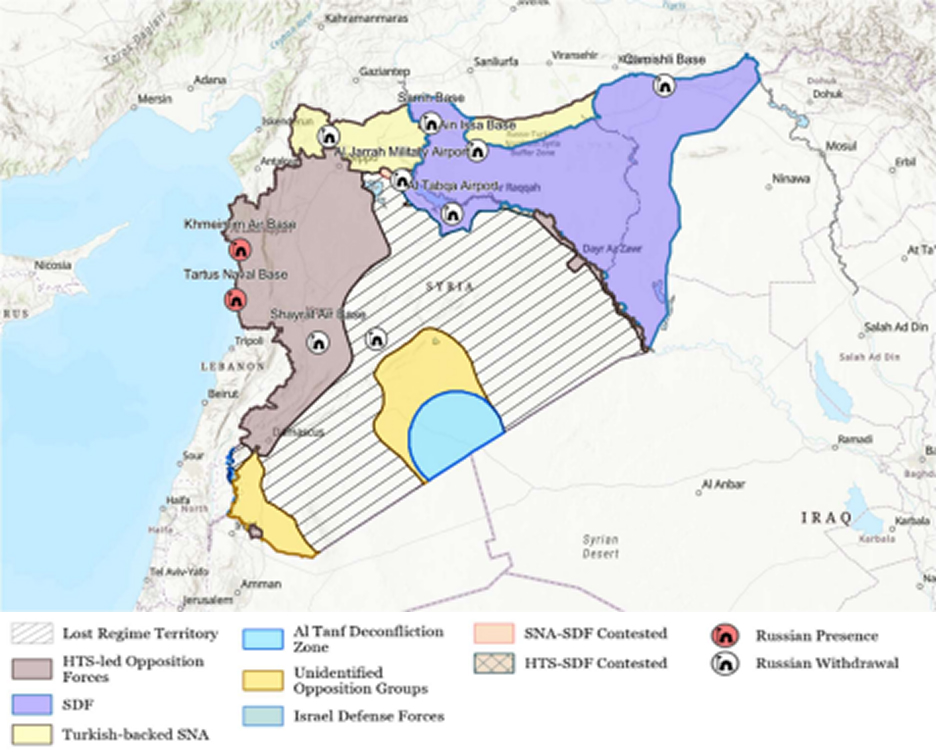
Source: Institute for the Study of War and AEI’s Critical Threats Project
Dr. Michael Barak opened the forum by contextualizing Syria’s current transition, highlighting the significant roles of the two main rebel groups: Hayat Tahrir al-Sham (HTS) under Al-Julani’s leadership and the Syrian National Army, both receiving substantial support from Turkey. Dr. Barak emphasized Iran’s active opposition to stability in Syria, citing concerns that a successful Syrian transition might inspire civil unrest within Iran itself.
Michael Goldfarb provided an extensive examination of Syria’s financial architecture, tracing its evolution from being one of the world’s most sanctioned countries since 1979 through the transformative 2019 Caesar Act. His analysis of General License 24 revealed both opportunities and limitations: while authorizing specific transactions with Syrian institutions and energy-related dealings, its six-month duration creates uncertainty for financial institutions. Goldfarb emphasized three critical requirements for Syria’s financial reintegration:
- Removal of Syria’s Designation as a State Sponsor of Terrorism: Essential for gaining trust from global financial institutions.
- Development of Local Financial Infrastructure: To meet international banking standards.
- Clear U.S. Assurances on Permissible Transactions: Through formal guidance and safe harbor provisions to eliminate ambiguities that deter financial engagement.
Jay Mens expanded the discussion to broader structural implications, describing Russia’s vision for Syria as a cohesive state capable of securing infrastructure, which contrasts with Iran’s vision for Syria as a fragmented system that allows for direct militia funding. He highlighted Turkey’s expanding role through embedded advisors and Qatar’s emerging financial support, including its planned $2 billion commitment for public sector salaries. The panel concluded with participants raising questions about Syria’s financial future, spanning regional dynamics, state-building challenges, economic considerations, and minority community concerns. Ultimately, the discussion highlighted the interconnected challenges of establishing a stable Syrian state while balancing regional interests.
Featured Panel Speakers
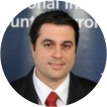
Dr. Michael Barak is a Senior researcher at the International Institute for Counter-Terrorism (ICT) at Reichman University, responsible for research on Palestinian terrorism and the Global Jihad research desk. He also lectures at the School of Government, Diplomacy, and Strategy at Reichman University and serves as a researcher on Egypt at the Moshe Dayan Center for Middle Eastern and African Studies.
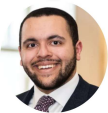
Jay Mens is the Director for MENA at Greenmantle, a geopolitical and macroeconomic advisory firm, and a Senior Fellow at Policy Exchange. He was previously an Ernest May Fellow for History and Policy at Harvard Kennedy School. With a B.A. in Politics and an M.Phil. in History from the University of Cambridge, Jay is also pursuing his doctorate in History at the University of Oxford. Fluent in six languages, including Arabic and Farsi, Jay writes extensively on international relations and global history.

Michael J. Goldfarb is a seasoned professional with extensive experience in the financial services industry. He has held senior management positions at various cross-border payments businesses, where he developed innovative approaches to facilitating flows to and from emerging and frontier markets, while maintaining best-in-class legal and regulatory compliance. Michael’s expertise stems from work in high-risk and post-conflict regions, including on behalf of major governments and organizations. He currently serves as Chief of Staff at CAB Payments, a UK-based provider of B2B foreign exchange and cross-border payments focused on the world’s hardest to reach geographies.
About CENTEF
CENTEF, the Center for Research of Terror Financing, is a global research institute dedicated to advancing the understanding of terror financing and its worldwide impact. CENTEF’s mission is to support global efforts to prevent terror financing by generating research, disseminating knowledge, fostering collaboration among experts, and funding studies in the field. CENTEF serves as an industry hub and a trusted broker and connector among academia, financial institutions, technology companies, regulatory bodies, and NGOs. The institute hosts conversations on best practices, vocabulary, and methodologies in the field of counter terror financing, facilitating cross-border and cross-domain collaboration to address global challenges.
Contact Us
Please feel free to contact us with any questions or should you require additional information:
Sharon Gal
CEO, Center for Research of Terror Financing (CENTEF)
Email: sharon@centef.org
