
Executive Summary
- On September 17, 2025, CENTEF, ICT, and Cognyte convened CENTEF’s first public workshop and roundtable on terror financing as part of Reichman University’s Shabtai Shavit World Summit on Counter-terrorism. The two sessions brought together regulators, agencies, researchers, financial institutions, and technology firms. The public session can be viewed on Youtube.
- The workshop drew ~100 participants and elevated terror financing to the forefront of one of the world’s premier counter-terrorism events.
- Key sessions highlighted Hezbollah’s financial crisis, the resilience of its global networks, and the growing role of fintech, crypto, and crime–terror links.
- The closed roundtable emphasized the urgency of international regulatory alignment, stronger sanctions, and the need for financial literacy among policymakers.
- The event positioned CENTEF as a global hub for terror-financing research and collaboration, paving the way for a forthcoming white paper and expanded engagement in Europe and the Gulf.
Overview
The 2025 Shabtai Shavit World Summit on Counter-Terrorism, hosted by ICT, drew more than 1,000 participants from Israel and around the world. The summit opened with two days of plenary sessions on the main stage, followed by two days of workshops across several auditoriums, all broadcasted live on YouTube and on the ICT channel with simultaneous English translation.
Within this global platform, on September 17, 2025, CENTEF hosted its first public workshop and roundtable on terror financing. The sessions were designed to elevate terror financing from a niche topic into a top-tier priority for decisionmakers, regulators, compliance officers, intelligence officials, and the broader public.
The workshop created a professional, multidisciplinary dialogue that transcended traditional silos and brought together experts from government, academia, the financial sector, and technology companies. For many participants, this was the first major public discussion on terror financing in Israel since October 7, 2023—and the first opportunity to see the full spectrum of perspectives on how these networks operate and adapt.
Rather than a single-discipline view, the event showcased how terror financing must be understood through multiple lenses: intelligence, regulation, innovation in fintech and crypto, and the role of state sponsors. This positioning reinforced CENTEF’s role as a hub that convenes diverse expertise and translates it into actionable insights.
Workshop Structure
The workshop combined depth with breadth, balancing fireside chats for focused conversations with panels that explored broader trends. Moderated by Michael (Mikey) Gallant, Chairman of CENTEF, the agenda was as follows:
- Opening Remarks – Michael Gallant set the stage by emphasizing the need for new cross-sector approaches to disrupt terror financing.
- Fireside Chat: Hezbollah After the War – Dr. Matthew Levitt provided a deep dive into Hezbollah’s current financial situation, underscoring both its vulnerabilities and the resilience of its global networks.
- Panel 1: The Next Generation of Terror Financing – Dr. Shlomit Wagman, Juan Montaner, and Omer Frenkel examined how fintech and crypto are reshaping the landscape of illicit finance, and the challenges regulators face in keeping pace.
- Fireside Chat: Dirty Money and the Crime–Terror Nexus – Adv. Ilit Ostrovitch-Levi, Director-General of Israel’s Money Laundering and Terror Financing Prohibition Authority (IMPA), highlighted how organized crime and terrorism increasingly share the same financial infrastructure.
- Panel 2: Iran, Qatar, and Turkey – The Terror Financing Axis – Dr. Udi Levy, Omer Frenkel, and Roy Agagny offered a strategic overview of state-sponsored financing, exposing both methods of operation and emerging red flags.
- Closing Remarks – Michael Gallant concluded by stressing the importance of collaboration across regulators, agencies, and the private sector to successfully expose and disrupt these networks.
Following the open workshop, CENTEF convened a closed-door roundtable: “Terror Financing After October 7th — What Has Changed, What Remains, and What Awaits Us?” This intimate session brought together 25 experts and stakeholders for candid dialogue under Chatham House rules. By invitation only, the discussion was not recorded, creating a space for leading practitioners to share perspectives on Hezbollah, Iran, regulatory gaps, and the future of disruption efforts.
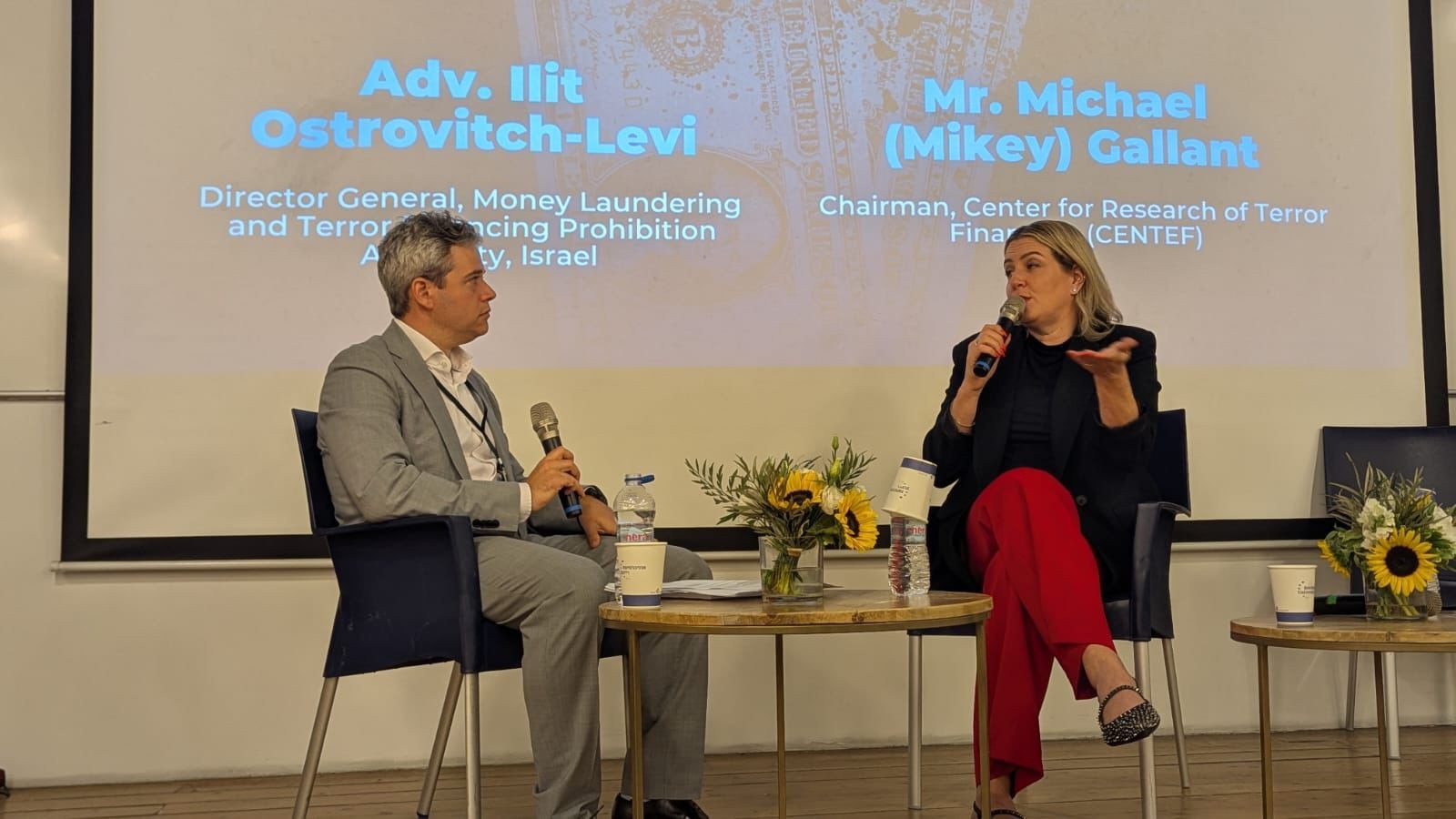
Left to right: Michael (Mikey) Gallant, Adv. Ilit Ostrovitch-Levi
Workshop: Key Insights
Dr. Matthew Levitt
Hezbollah After the War
- Hezbollah sustained financial damage during the recent conflict, but not as much as many believe; Iran continues to transfer substantial funds, though the group’s needs now exceed those inflows.
- Funding channels rely heavily on a network of licensed and unlicensed hawala operators across Lebanon, Iran, and Iraq—sometimes referred to as the “dirty dozen.”
- Banque du Liban recently stated that financial services cannot be provided to Al-Qard Al-Hasan, Hezbollah’s so-called “bank.” Despite this, the institution remains active under the guise of a charity and generates revenue through the Lebanese real-estate market.
- Hezbollah’s illicit finance and procurement networks overlap, complicating disruption efforts; many activities are based in free trade zones where oversight is weak.
- Designations alone are insufficient; without operational authority and enforcement, groups adapt and reconstitute.
- A stronger international coalition is needed to deny groups like Hezbollah the ability to procure weapons, raise funds, or operate within permissive jurisdictions.
Implications
Hezbollah remains financially agile despite sustained pressure. The critical task for the international community is to identify and explain these hidden financial lifelines — hawalas, shadow banks, real estate channels, and free trade zones — in order to enable more effective government and enforcement action. CENTEF supports this effort by researching, documenting, and presenting these networks in ways that inform policymakers, regulators, and the broader public.
Dr. Shlomit Wagman
The Next Generation of Terror Financing: Crypto and Fintech
- The type of coin matters: larger, regulated cryptocurrencies (e.g., Bitcoin, USDC) are easier to trace and sanction, while less-regulated tokens (e.g., USDT) are harder to confiscate and therefore more attractive to illicit actors. Hamas, for example, abandoned Bitcoin fundraising once it became too easily tracked.
- Estimates suggest that illicit activity accounts for less than 10% of the crypto economy — comparable or lower than illicit use of FIAT, which stands at 15–20%.
- Current blockchain analytics remain limited: they are largely retrospective and forensic, covering only a small fraction of overall transactions.
- A second generation of blockchain analysis tools is needed to provide near real-time monitoring and intervention, across multiple platforms.
- AI agents, when well trained on financial data, are proving more efficient than human analysts in detecting anomalies and suspicious flows.
Implications
Crypto-financing by terror groups is shifting toward less-regulated stablecoins and away from mainstream tokens, exploiting the current weakness of retrospective-only monitoring. The priority for governments and regulators is to invest in next-generation, real-time analytics and ensure that policy frameworks can adapt to new tokens as they emerge. CENTEF’s role is to highlight these evolving risks and technical gaps, translating complex developments into insights that can inform policymakers and enforcement agencies.
Juan Montaner
Operational Use of Crypto by Terrorist Organizations
- Legal cases have already shown that over $300 million in cryptocurrency has been used by designated groups such as Hamas, Hezbollah, ISIS, al-Qaeda, and Lashkar-e-Taiba, with volumes growing rapidly as younger, tech-savvy donors adopt digital assets.
- The modus operandi typically involves fake IDs and small intermediaries (often hawala-like operators) who aggregate funds before routing them through large exchanges with deep liquidity. The exchanges often cannot distinguish whether the intermediary’s transactions are for legitimate or illicit purposes.
- Weak enforcement in Africa, especially in the Sahel, creates one of the most significant blind spots for counter–terror financing (CTF). Countries in the region lack the resources and regulatory capacity to police flows.
- The rise of the digital dollar in under-regulated jurisdictions with few financial intelligence units (FIUs) increases exposure: digital currencies are widely used, but oversight is minimal.
- The broader crypto economy is massive—with a market capitalization estimated at $4 trillion—making illicit flows harder to isolate and disrupt at scale.
Implications
The use of cryptocurrency for terror financing is growing both in scale and sophistication, particularly in regions with weak regulatory capacity and through liquidity hubs where large exchanges lack full visibility. Effective disruption will require closing jurisdictional blind spots, building FIU capacity in vulnerable regions, and enhancing due diligence obligations at major exchanges. CENTEF contributes by documenting these operational patterns and underscoring where enforcement gaps and blind spots must be addressed.
Maj. (Res.) Omer Frenkel
Analytics and Predictive Technology
- Current counter–terror finance tools are largely investigative and retrospective; the field urgently needs predictive systems that can surface risks and suspicious networks before funds are deployed.
- Full de-anonymization requires fusion across multiple domains—financial data providers, OSINT, SIGINT, IP interception, and broader cyber/metadata streams.
- Analysts face bottlenecks: they must be well trained in both finance and AI-driven tools to interpret data effectively and overcome analytic barriers.
- In practice, OSINT often provides higher-value leads for mapping financial activities, with SIGINT and cyber serving more as complementary inputs.
Implications
Shifting from retrospective investigation to predictive analytics is central to closing gaps in terror finance disruption. This requires investment in multi-source fusion platforms and in specialized analyst training that blends financial literacy with technical expertise. CENTEF’s role is to spotlight these needs and convene dialogue between regulators, technologists, and enforcement bodies to accelerate adoption.
Adv. Ilit Ostrovitch-Levi
The Crime–Terror Financing Nexus
- “There is no legitimate money that funds terror; all funding for terrorism is derived from criminal activity.” The overlap between financial crime and terror financing is so significant that most FIUs are tasked with both.
- October 7 served as a wake-up call for European agencies, exposing major intelligence gaps. Israel provided leads that helped establish CTFTI—an international task force chaired by Israel, Germany, the Netherlands, and the U.S.—which produced a comprehensive 300-page intelligence map of Hamas entities.
- The Israeli FIU has already mapped extensive networks of individuals, companies, bank accounts, NGOs, and money service providers, generating actionable intelligence to prioritize targets.
- A persistent challenge in the West is the lack of a dedicated terror-financing statute. Cases are often prosecuted as money laundering, undermining the specificity and deterrent power of TF legislation.
Implications
Terror financing cannot be disentangled from financial crime, requiring both legal recognition and institutional coordination. The experience of October 7 shows that task-force models and intelligence mapping can yield powerful results, but broader adoption depends on legal reform and international cooperation. CENTEF can add value by documenting best practices and highlighting where statutory and institutional gaps undermine enforcement.
Dr. Udi Levy
Hamas Captured Documents and Operational Insights
- The IDF seized thousands of financial documents in Gaza, revealing Hamas’ bankers, funding sources, NGO ties, and procurement networks. These materials are not classified intelligence and should be made public to empower researchers and the wider community.
- Since Assad’s departure from Syria, Hezbollah and Iran have shifted much of their captagon production and trade to Yemen, adapting their operations to changing regional dynamics.
- While leaks such as WikiIran exposed significant parts of Iran’s financial infrastructure, the core problem is often not intelligence gaps but lack of analytic capacity and political will in the West to act decisively.
- Hamas’ continued access to funds directly enables recruitment: with extremely high unemployment in Gaza, the promise of a salary is enough to bring in new members. We will not be able to prevail as long as Hamas receives cash flows into Gaza.
- Stronger legal and regulatory frameworks are needed to hold financial intermediaries accountable. For example, Binance now faces lawsuits over its role in financing activity tied to October 7.
Implications
Financial documents and captured materials are invaluable for mapping terror financing, but their impact depends on transparency, analysis, and the willingness to act. Disruption efforts must combine public exposure of illicit ties, investment in analytic capacity, and stronger legal accountability for financial intermediaries. CENTEF can support by translating raw material into accessible financial and criminal-terror finance research that broadens awareness and drives policy responses.
Roy Agagny, CPA
State-Linked Finance and Soft Power
- Iranian shadow networks often rely on family-based structures. One such network, led by three Iranian brothers, registered dozens of companies across the UAE, Qatar, Hong Kong, and elsewhere. These fronts facilitated payments for unreported oil sales (notably to China) and channeled funds to terror groups and Iran’s missile program. The network was sanctioned by the U.S. in 2025.
- Qatar has invested more than €1 billion in strategic assets in the West over the past decade—including stakes in the London Stock Exchange, Citi, Barclays, Heathrow Airport, and even iconic assets such as the Empire State Building and European football clubs. These investments provide both soft power influence and a financial shield against scrutiny.
- In parallel, the Qatar Foundation for Education has spent billions financing Muslim institutions and activities in the West—from schools and summer camps to mosques, university programs, and scholarships. In the U.S. alone, such investments total more than $5 billion.
- This blend of soft power and financial activity creates fertile ground for political influence, anti-Israel activism, and the spread of extremist ideology. The case of Texas A&M’s research facility in Qatar—where nuclear research IP was contractually owned by Qatar until the program was shut down after public backlash—illustrates the risks.
Implications
The overlap between state-directed shadow finance and soft power investment blurs the line between influence-building and direct support for terrorism. Effective countermeasures require deeper ownership transparency (UBO), oversight of foreign investment, and scrutiny of philanthropic flows that may serve as ideological or financial shields. CENTEF contributes by mapping these patterns and highlighting how soft power and terror financing intertwine in ways that require stronger policy responses.
Closed Roundtable - Key Insights
Panelists: Michael (Mikey) Gallant, Dr. Eitan Azani, Dr. Emmanuele Ottolenghi, Nir Klaron.
Hezbollah – Roundtable Summary
- Crisis in leadership and finances
Hezbollah is undergoing its deepest crisis in decades. Tiers 1–3 of leadership have been eliminated, leaving Tier 4 and lower to rise, but little is known about these figures. - Budget profile
The organization’s annual budget is estimated at $1.1–2 billion. Roughly 50% comes from Iran and 50% from non-state sources (criminal activity and Da’wa fundraising). - Iranian contribution: Severely disrupted, but money still flows.
- Non-state contribution: Largely unaffected and expected to grow, given weak global political will and increased public sympathy in some constituencies.
- Weaknesses in financial monitoring
Financial institutions continue to use Western compliance standards that miss the reality of Hezbollah’s clan-based networks. Failures include: - Not screening names in their original languages.
Not widening the circle of scrutiny to family and clan ties. - As a result, facilitators often remain undetected and not even flagged as “high risk.”
- Shift to new infrastructure
With Al-Qard Al-Hassan dismantled, Hezbollah has the opportunity to rebuild its financial architecture using digital banking, fintech, and crypto, potentially making future networks more agile and opaque. - Policy takeaway
Effective disruption campaigns against Hezbollah and its sponsors (Iran, Russia, and others) must be multinational, data-driven, and comprehensive. Any loophole in sanctions, regulatory coverage, or enforcement risks undermining the entire effort.
Dr. Emanuele Ottolenghi
Persistence of Illicit Trade Routes & the Need for Targeted Pressure
Key points
- Illicit financing mechanisms and established trade routes are self-sustaining: if cocaine trafficking and money-laundering remain profitable, actors will continue to rely on them. Disruption must therefore target both the mechanisms and the logistics that sustain them.
- Authorities should use tools that have worked elsewhere, even if they have not been applied historically in this context. For example, in 2022, diverting and denying refueling to an Iranian aircraft forced it to jettison cargo was a tactical intervention that leveraged operational pressure rather than relying solely on sanctions.
- Current sanctioning strategies are insufficiently comprehensive. It is not enough to sanction low-level smugglers; enforcement should extend to port operators, commercial enablers, and complicit officials who facilitate illegal trade.
- Sentencing and deterrence are weak. Punishments are often too lenient or delayed (one case cited where an operative’s sentence was effectively served prior to conviction), undermining deterrence and public confidence.
Implications
Tactical and strategic pressure must be broadened: combine targeted operational measures (e.g., interdiction, logistical denial) with a more expansive sanctions and accountability regime that reaches the commercial and political enablers of illicit trade. Legal reform to ensure timely and meaningful sentences is also necessary to deter participation in these networks. CENTEF’s role is to document effective tactics and advocate for policy approaches that pair operational interdiction with systemic sanctions and accountability.
Dr. Eitan Azani & Other Participant Remarks
Priority, Collaboration, and Operational Focus
Key points
- Prioritize and pressure a concrete channel: The most effective approach is to select a single priority channel (Azani: “against Iran”) and apply sustained, relentless pressure rather than diffuse efforts.
- Monitor Hezbollah’s rebuild: It is essential to track how Hezbollah reconstructs its financial infrastructure and to identify which internal unit assumes responsibility for those activities.
- Multidisciplinary, strategic collaboration: Counter-financing of terror (CFT) must be designed as a multidisciplinary, multifaceted, and collaborative effort — aligning regulators, intelligence, law enforcement, financial industry, and technologists.
- Regulatory clarity and implementation: Clearer, stronger regulation is required, but participants acknowledged that passing and enforcing rules can be difficult; practical pathways to implementation are needed.
- Expose and deter via reputational pressure: Public exposure of enablers (commercial, philanthropic, and financial) creates reputational risks that can prompt private-sector divestment and reduce permissive environments.
- Lower technical barriers for intelligence use of financial data: Participants called for easier mechanisms and tools to enable intelligence officers to analyze and act on financial data.
- Sustain focus on the crime–terror nexus across platforms: Emphasis on continuing to highlight and investigate the intersection of criminal networks and terror financing across payment rails, platforms, and currencies.
- Anticipate reconstruction flows: With large reconstruction funds expected for Gaza, CENTEF and partners should proactively publish best-practice guidance to reduce exploitation of rebuilding finance.
Implications
The roundtable stressed that tactical selectivity, sustained pressure, and cross-sector coordination are essential to make disruption stick. Prioritizing a clear target area (e.g., channels tied to state sponsors) enables concentrated legal, financial, and operational measures. Transparency and reputational strategies complement regulation by inducing private-sector action where legal tools lag.
Recommended next steps
- Develop a short briefing on how Hezbollah could rebuild its finance functions (units, tools, likely channels) to inform enforcement priorities.
- Produce a guidance note on reputational exposure (criteria for public naming, evidence standards, communication strategy) to support coordinated private-sector divestment.
- Pilot tools or workflows that lower the analytic bar for intelligence units to work with financial datasets (pre-packaged queries, analyst training modules).
- Advocate for a focused multinational initiative that pairs sustained pressure on a selected channel with synchronized regulatory/back-end actions across major jurisdictions.
(As with other sections, CENTEF’s contribution is to research, document, and translate these priorities into actionable briefs and convenings for policymakers, industry, and enforcement.)
Achievements
- The workshop positioned CENTEF as a global hub for experts, policymakers, and the wider public engaged in counter terror financing.
- Built new connections with regulators, researchers, and industry practitioners, expanding CENTEF’s international network.
- Elevated terror financing to the top of the agenda at one of the world’s leading counter-terrorism conferences, attended by more than 1,000 participants from around the globe.
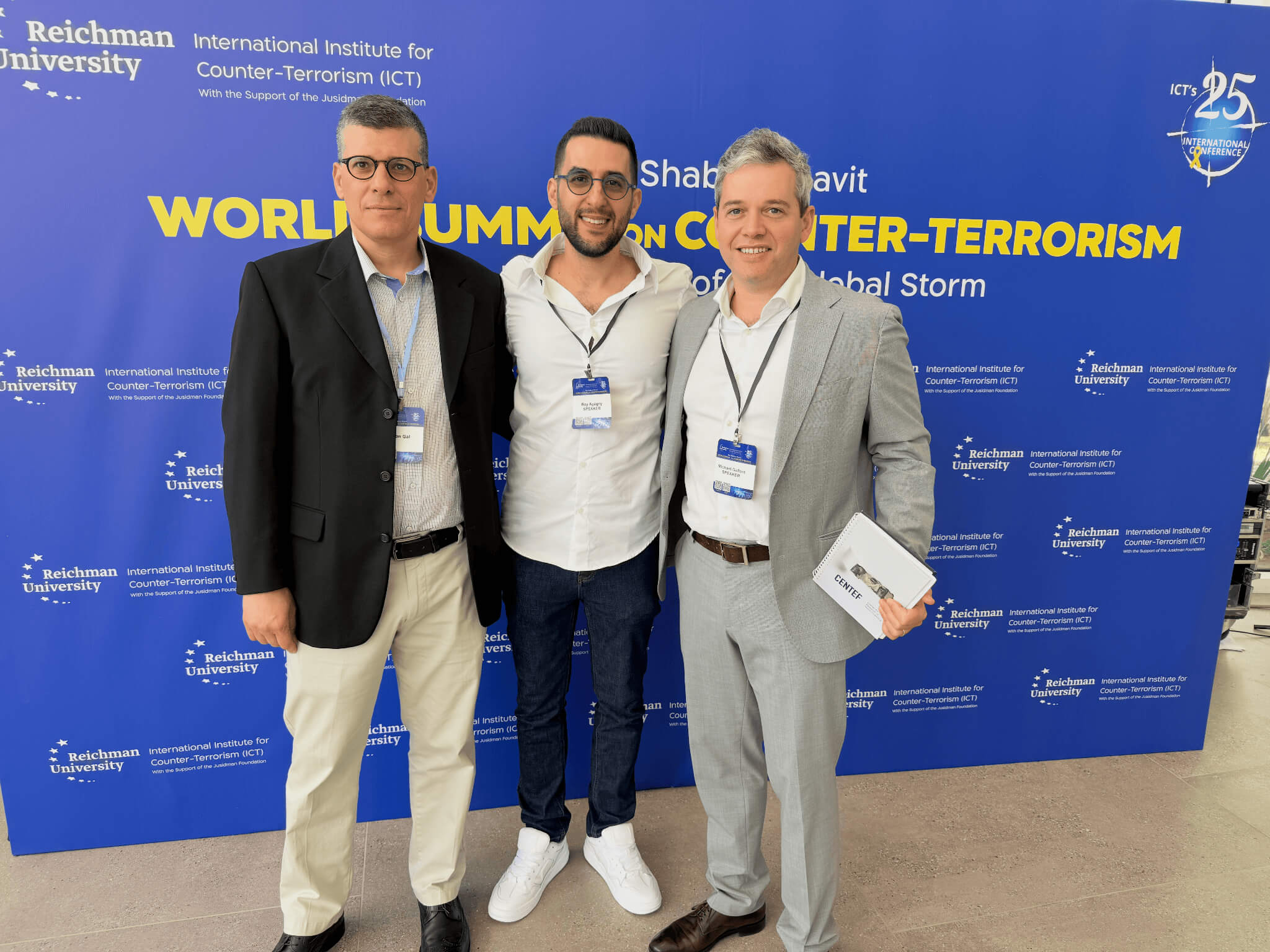
Right to left: Michael (Mikey) Gallant, Roy Agagny, Sharon Gal
